Optimize the systems that keep your compute running flexibly.
Reliable compute depends on a connected facility: utility power and backup paths, UPS and distribution equipment, IT racks, air handlers, chilled-water equipment, heat rejection, and site controls. The exact mix varies with climate, density, redundancy strategy, and whether the site uses air, liquid, or hybrid cooling.
There is no universal setpoint or one-size-fits-all optimizer.
Taber combines process engineering with data-driven forecasting and optimization to improve system performance considering the unique nuances of each facility's equipment conditions, and stakeholder priorities.

A Typical Facility, Viewed as One System
Critical IT loads typically use the UPS path, with a bypass path available. Cooling and other facility loads often have separate switchgear feeds. Heat follows its own path out, while controls and operating limits connect the systems.
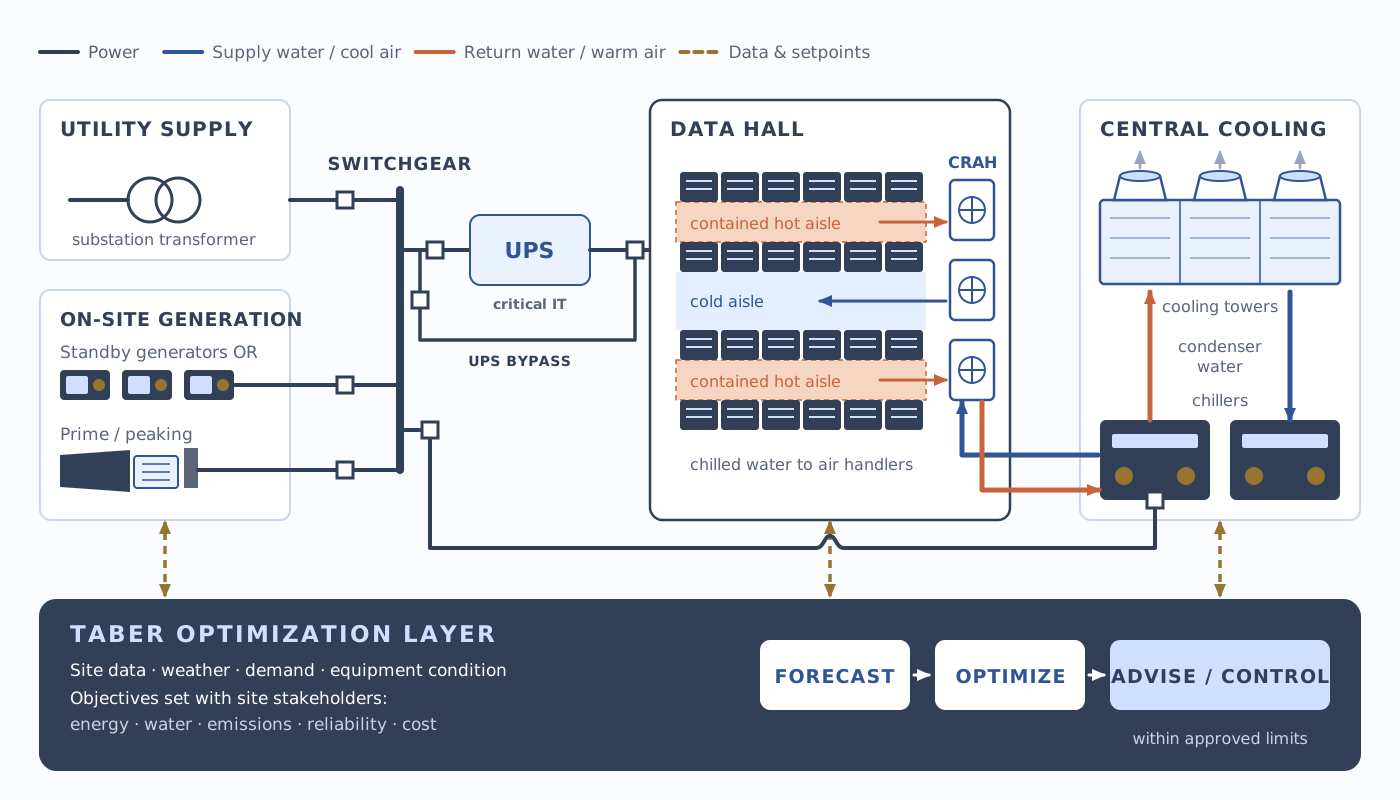
Illustrative example: many facilities use a different cooling or redundancy configuration. Direct expansion, air-side or water-side economizers, direct-to-chip liquid cooling, dry coolers, and alternative power architectures can change the arrangement.
Many Opportunities Across a Campus, Including:
Cooling & Thermal Systems
Forecasting & Cooling
Forecast heat load and weather to stage chillers, pumps, and tower fans. Taber’s work has delivered double-digit cooling-power savings and several-percent water savings; sites with more headroom may go further.
DOE identifies cooling setpoints, fan and pump speed control, economizer use, and part-load equipment efficiency as key opportunities. DOE Best Practices Guide
Temperature Management
Hold supply-air, chilled-water, and process temperatures steady through load swings, reducing excursions and thermal stress. Taber has reduced temperature swings at utility thermal plants by applying the same disciplined control approach.
On-Site Generation
Generator Performance
Improve efficiency and heat rate of on-site generation across changing load, building on Taber’s demonstrated heat-rate improvements at thermal power plants.
Generator & Equipment Utilization
Plan which backup generators and other site assets run, when, and at what load. Coordinate readiness exercises, permitted runtime, light-load wet-stacking risk, and equipment wear.
See EPA’s 2025 RICE guidance and the NFPA 110 load-testing FAQ.
Emissions Control
Taber’s ammonia optimization has reduced reagent consumption by 15% or more while supporting NOx compliance; results vary by unit.
Site Operations & Reliability
Asset Utilization
Get more from installed cooling and support equipment by running the right units at the right operating points for current load, weather, and redundancy requirements.
Reliability & Maintenance
Spot equipment drift early, separate actionable alarms from noise, and realize predictive maintenance with informed data analysis and expert-guided anomaly detection.
LBNL’s NERSC work shows the value of combining facility and IT data for ongoing analysis. LBNL Operational Data Analytics
Every site is different, Taber shapes each application around the installed equipment, local conditions, and the priorities of facilities, IT, power, and sustainability stakeholders to achieve a fully customized and directly relevant suite of solutions.

A Practical Path to Improvement
Understand the site
Map the equipment, data sources, operating modes, constraints, and objectives that define success at this facility.
Build and test
Combine process knowledge with measured data. Compare candidate strategies against historical behavior, defined limits, and site priorities.
Deploy in stages and keep improving
Start with monitoring or recommendations. Move toward control only when the site approves the objective, safeguards, and validation plan, then keep refining as conditions and priorities change.
Taber selects methods to fit the problem: established engineering, conventional control, data-driven models, or a hybrid. The goal is a useful, maintainable improvement that fits the facility, not AI for its own sake.

Technical Reading Behind These Opportunities
These sources describe general industry opportunities and research findings. Their results are not Taber results or predictions for a particular site.
- U.S. DOE, Best Practices Guide for Energy-Efficient Data Center Design: airflow separation, cooling controls, fan and pump speed, economizers, part-load efficiency, and PUE/WUE/ERE/CUE metrics.
- U.S. DOE FEMP, Cooling Water Efficiency Opportunities: thermal path and energy-water tradeoffs.
- Lawrence Berkeley National Laboratory, Operational Data Analytics at NERSC: combining building and IT data for operational monitoring and cooling-system analysis.
- Grahovac et al., Model-based data center cooling controls comparative co-design: a modeled chilled-water plant comparison reported lower energy use with alternative control logic; outcomes are specific to that modeled configuration.
- Chang et al., Optimization Control Strategies and Evaluation Metrics of Cooling Systems in Data Centers: review of cooling approaches, control optimization, airflow, and evaluation metrics.